 by cooked
axiom mev protection: off, reduced, secure
Axiom has three MEV modes, Off, Reduced and Secure, and Secure is the one it recommends, at the cost of waiting for a whitelisted validator. They sit with the other execution settings, and the current minimum bribe is shown on the hand-and-coin icon in the top right corner.
| Mode | What Axiom says it does |
|---|---|
| Off | no protection, trades exposed to front-running |
| Reduced | via Jito, but rogue validators may still be involved, so exposure remains |
| Secure | waits for a whitelisted validator, which can be slower |
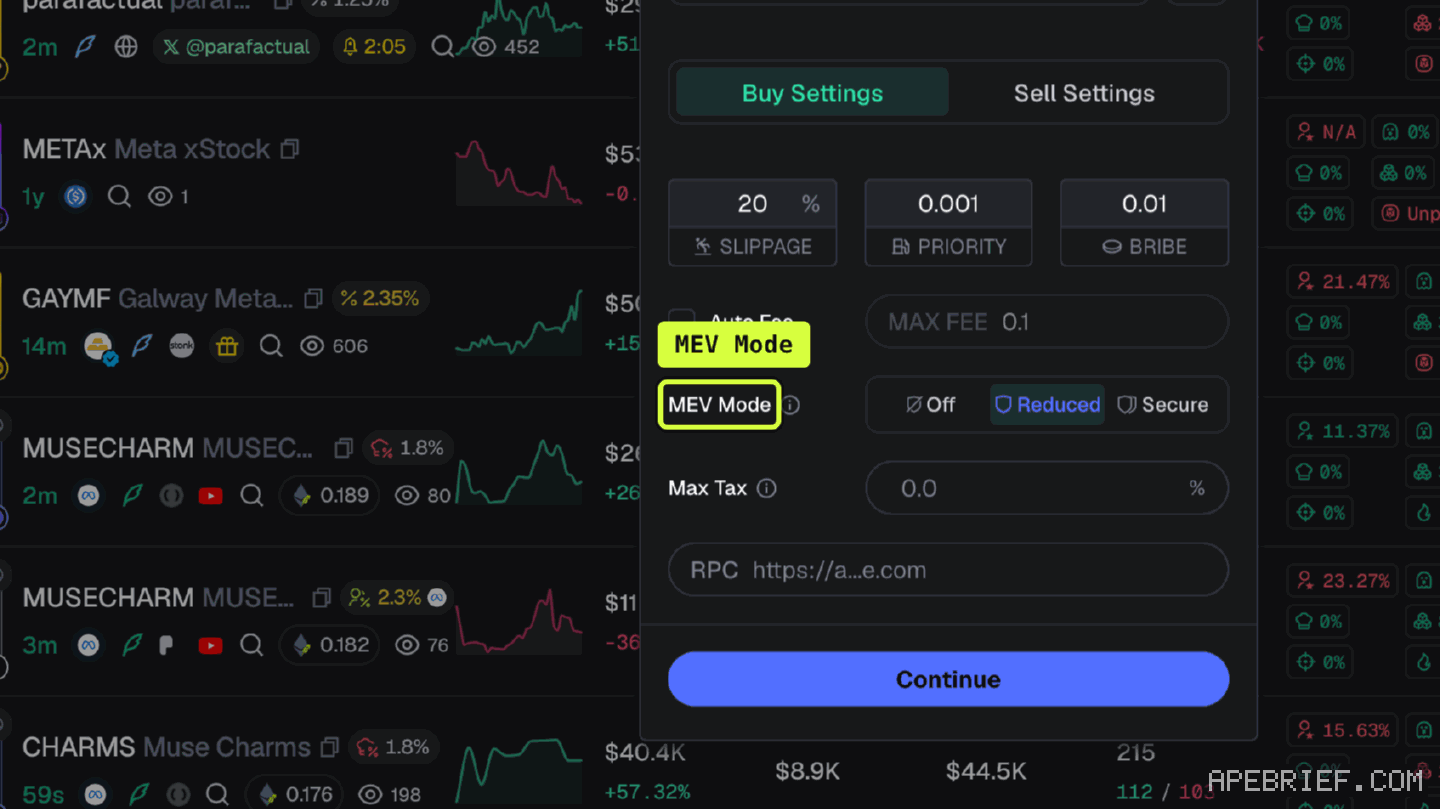
what you are trading away
Secure is slower. That is not a bug in the mode, it is the mode. It waits for a validator it trusts, and while it waits the price moves. On a contested launch that delay is the difference between the fill you wanted and no fill.
So the real question is not "should I use protection" but "am I in a race". If you are not, use Secure, because the cost is a few seconds you were not using anyway. If you are, you are choosing between a worse fill and no fill, and both are real answers.
Axiom is explicit that a higher bribe increases safety and is not fully effective.
the two things people get wrong
Protection is for buying. Axiom says MEV protection is only necessary for buy transactions and does not need to be enabled for selling on most tokens. If you have it on for everything and your sells feel slow, that is why.
Protection off means slippage low. Axiom says it directly: if you are not using MEV protection, keep slippage low so the transaction does not get sandwiched. Those two settings are one decision. Turning protection off is defensible. Turning it off while a wide slippage limit sits there authorising any price is how the sandwich pays for itself.
If you are checking one field before your next buy, check the minimum bribe indicator against what you have set. Below the minimum, the protection you think you enabled is not doing the job.
None of these settings moves Axiom's platform fee, which is a separate number and lives on the fees page. If you're setting up a new account, the link below is our referral link.
Signing up through this link takes 10% off your Axiom trading fees, which signing up without one does not. We get a commission from Axiom, which helps support our work, at no extra cost to you. We might add tools for people who used our code.
Tapping the button puts apebrief on your clipboard and opens Axiom. Where the signup shows a code field, paste it there.
People also ask
What does Axiom actually charge?
Platform fee starts at 1% of the fill, plus priority you set, plus impact. A referral is a fee cut on the account if the field shows the code. Gas is separate.
the full answerI swapped on Axiom and the token is gone
Check the tx on a Solana explorer first. Destination address and mint are the ground truth. Then enable that mint in the wallet. Do not swap again to find it.
the full answerHow we know: every number on this page
8 sources
- the three MEV modes Axiom offers 3 · source2026-08-28
- what each mode does modes · source2026-08-28
- Axiom's own recommendation secure · source2026-08-28
- protection is not absolute, in Axiom's own words not · source2026-08-28
- where the current minimum MEV bribe is displayed, and that protection is aimed at buys minimum · source2026-08-28
- Axiom's guidance to keep slippage low when protection is not on slippage · source2026-08-28
- the only attachment mechanism Axiom documents is signing up through a referral link; the page describes no referee-side code field, no post-signup entry, no retroactive attachment and no cookie, wallet or device behaviour signup · source2026-09-16
- Axiom gives users who sign up through a referral link a 10% discount on trading fees 10% · source2026-09-24
next
- axiom fee tiers: the cashback and net fee at each tierAxiom pays cashback in SOL against its own trading fee, from 0.05% at the lowest tier to 0.25% at the highest, which is why Axiom gives the net fee as 0.95% rather than 1%.
- where the priority fee and the bribe are on axiomBoth live behind the settings button in the top right, as PRIO and Bribe, and Axiom documents a default of 0.001 for each.
- where to change slippage on axiomSlippage is the Max % field in the settings panel behind the button in the top right, and Axiom's own example is that 1000% accepts up to a 10x price move before it cancels.
- Which chains does Axiom trade?Eight, on Axiom's own screen: Solana, Robinhood, Arc, BNB, Ink, HyperEVM, Base and Ethereum.
- compareAre Axiom perps just Hyperliquid?Hyperliquid directly if the fee decides it: Axiom's Perpetuals screen trades on Hyperliquid, and Axiom adds 0.01% per transaction on top of Hyperliquid's own fee.